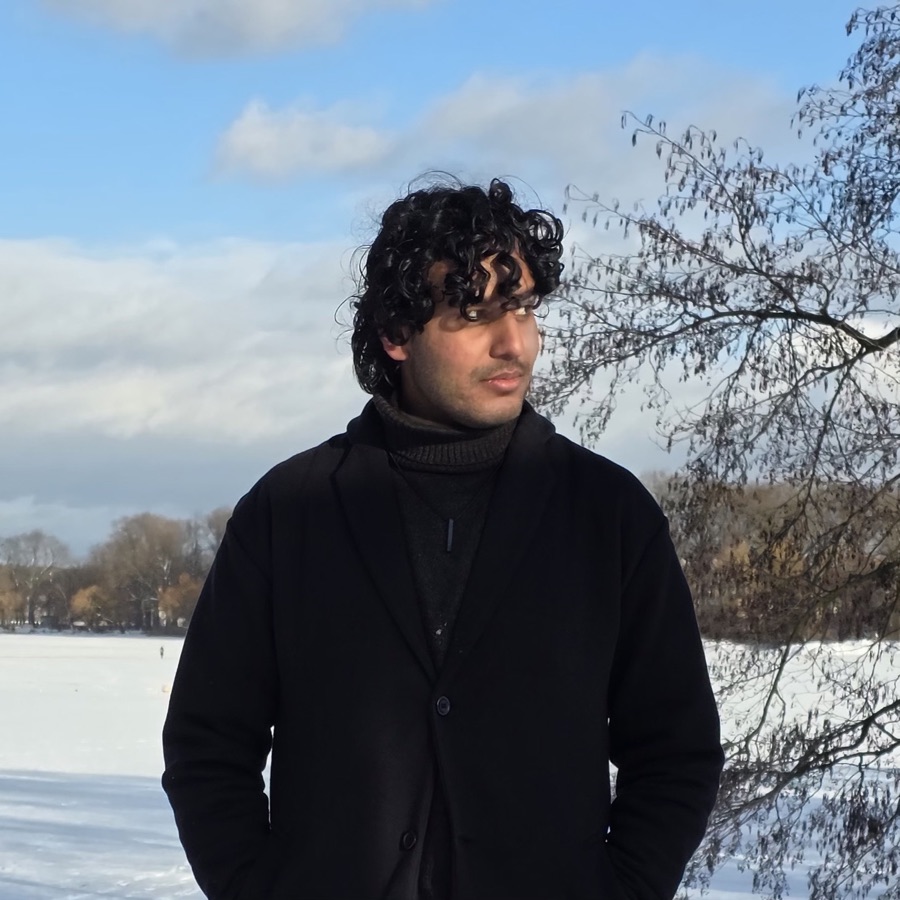

Talha Masood

Full-stack engineer, internal tools

Over four years building software: two and a half full-time on production web and mobile apps, then two part-time on research and test tooling alongside my M.Sc. Right now I'm at Proxima Fusion, turning a task-run graph too dense to read into one scientists can actually use.

Try the graph I redesigned
Portrait of Talha Masood
Working student while finishing my M.Sc. · full-time from October 2027

About

The work I enjoy most sits between people and their data: the internal tools that decide whether a scientist finds the failed run in ten seconds or ten minutes. Alongside work I'm finishing an M.Sc. in Computer Science at the University of Stuttgart; my bachelor's in Computer Engineering at FAST-NUCES ended with the gold medal.

I like owning a feature from end to end: the data model, the API, the interface, the tests and the pipeline that ships it. Before moving to Germany I spent two and a half years in Lahore building a real-estate platform for agents in the UAE; since then I've worked on antenna testing at Mercedes-Benz and research tooling at Proxima Fusion.

Making dense data readable
Graphs, explorers and dashboards that surface the one thing that matters.
Shipping without ceremony
A preview on every pull request, so people try a change before it lands.
Testing LLMs honestly
Agent pipelines scored against ground truth, not eyeballed.

Experience

Three teams, and the parts of each job I'd most want you to know about. The full history is in my CV.

  1. Proxima Fusion

    May 2026 – Present

    Munich, Germany, working student

    Software Engineer, Working Student

    Proxima's scientists run a lot of computations, and I build the internal tools they use to keep track of them.

    The piece I'm proudest of is the task-run graph. Lineages had grown so dense they stopped being useful, so I designed an aggregation that groups runs by the object they act on, their direction and their task type, without merging lineages that are genuinely independent. On the worst production graph it cut 1,388 nodes to 52.

    I also made every pull request deploy its own staging-like environment in about five minutes. More than 40 scientists and the AI agents across the company use them: whoever opens the pull request shares the link with the people who asked for the change, so they can try it before it merges. And I built the explorer they use to find the failed, slow or uncommitted runs.

    Try the rebuilt graph
    • TypeScript
    • React Flow
    • FastAPI
    • Terraform
    • Cloud Run
  2. Mercedes-Benz AG

    Sep 2024 – Apr 2026

    Sindelfingen, Germany, working student

    Software Engineer, Working Student

    I joined the over-the-air antenna testing team, which measures how well a car's antennas perform.

    The test benches were the bottleneck, so I wrote a scheduler that runs tests concurrently on whichever benches are free: throughput went from about 25 tests a day to 44 (+70%).

    Then I built a dashboard for the results, which cut the time our six test engineers spent on manual review by 80%, and moved the services onto Docker and Jenkins so a deploy became repeatable and took about six minutes.

    • Node.js
    • Vue.js
    • Docker
    • Jenkins
  3. Dubizzle Labs

    Oct 2021 – Apr 2024

    Lahore, Pakistan, full-time

    Full Stack Developer

    Two and a half years on Profolio, a mobile and web app for real-estate agents in the UAE, serving more than 100,000 users. I was one of three engineers building the new app, working with the project and product managers and directly with the product designers on design and UX decisions.

    I built TruLeads, which sorts leads by how agents have actually interacted with them and lifted agent conversion by 20%, and ProConnect, where about 10,000 agents share listings and coordinate deals over real-time chat. Reworking key mobile flows with the product team brought 15% more app downloads.

    App Store(opens in a new tab)Google Play(opens in a new tab)

    • React Native
    • TypeScript
    • Laravel
    • Elasticsearch
    • AWS

Task-run graph: 1,388 nodes → 52

The task-run graph I redesigned and shipped at Proxima Fusion, rebuilt here on mock data so you can try it. Switch to Before to see the problem it solved.

Built at

Proxima Fusion

Software Engineer, Working Student
May 2026 – Present

Problem
One busy object could fan out into 100+ nodes. Every task run was drawn separately, and zoomed to fit, nothing was readable.
Approach
Runs of the same task type collapse into one node you can step through. Task groups are added on demand from a + menu, so you build the path you care about one step at a time.
Result
On the worst-case graph in Proxima's production data: 1,388 → 52 nodes and 1,888 → 53 edges.

Projects

FeaturedApplied LLMs

Can small open models write CAD?

A three-person university project: can small, free AI models turn a sentence like "a box 80 × 50 × 30 mm" into a working 3D CAD model?

I built the FastAPI backend and the Next.js frontend: type a request, see the part in 3D, download the files.

Models compared

  • Qwen2.5-Coder-7B-Instruct
  • Llama-3.1-8B-Instruct
  • Gemma-2-9B-it

The code is private. I'm happy to walk you through it.

How it works

  1. Understandturns the request into a checklist of features and dimensions.
  2. Buildwrites CAD code in Python (CadQuery) and runs it safely to produce 3D files.
  3. Checkcompares the part with the checklist and asks for a fix, up to three tries.
Stack
Python, vLLM, CadQuery, FastAPI, Pydantic, Next.js, Three.js

What we found

5 test parts, simple to hard · 10 runs per model

Qwen2.5-Coder-7B-Instruct won on both understanding and accuracy. Simple parts work; complex ones, like a chair, are still out of reach.

Weak spot: the check step only compared a part's size, position and volume, never its actual shape. So on medium and hard parts, it got every pass/fail verdict wrong.

Show the results chart

Share of the request's requirements the model picked up correctly.

  • Qwen2.5-Coder-7B-Instruct
  • Llama-3.1-8B-Instruct
  • Gemma-2-9B-it

Qwen2.5-Coder-7B-Instruct understood the most on every part. The other two caught less than half of what was asked.

Request Interpretation by part and model (higher is better)
PartQwen2.5-Coder-7B-InstructLlama-3.1-8B-InstructGemma-2-9B-it
Box (simple)80%35%20%
Cylinder (simple)90%21.7%47%
Plate with holes (medium)73%20%29%
Stepped shaft (medium)71%20%21.8%
Chair (hard)67%20%6.9%

Computer vision

Real-time body posture classifier

Can an ordinary camera tell whether you're sitting, standing or lying down? This one can, 95% of the time: MediaPipe pulls 33 body landmarks from every frame and a k-nearest-neighbours classifier does the rest.

Stack: Python, MediaPipe, scikit-learn, OpenCV

The code is private. I'm happy to walk you through it.

IoT and ML

Vertical farming system

An indoor growing rack you run from your phone. The Flutter app switches and schedules water, light and air, and a small TensorFlow model suggests which crop to plant for the current conditions.

Stack: Flutter, Django, TensorFlow

The code is private. I'm happy to walk you through it.

Contact

Hiring, building something interesting, or curious about anything on this page? Write to me; email reaches me fastest.

Location
Stuttgart, Germany

Working student while finishing my M.Sc. · full-time from October 2027

Write a message

Fill this in and it opens as a ready-to-send draft in your email app.

0 / 800